
 Français
 Deutsch
 Español


- New




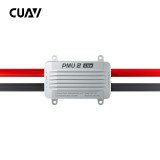
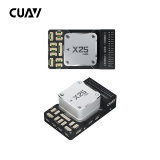
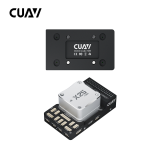
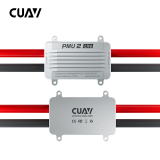
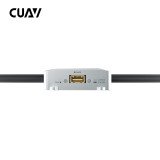
-Industrial-grade STM32H7 autopilot with triple redundant IMUs, advanced vibration isolation.
-16 PWM outputs, 100 Mbps Ethernet, dual CAN, and PMU 2 Lite power management.
The CUAV X25 EVO is a next-generation industrial-grade autopilot designed for professional UAVs, fixed-wing aircraft, VTOL platforms, multirotors, helicopters, and autonomous robotic systems.
Powered by a high-performance STM32H753 processor operating at 480 MHz, the X25 EVO combines triple redundant industrial-grade IMUs, dual barometers, an RM3100 electronic compass, and advanced vibration isolation technology.
Featuring 16 PWM outputs, dual CAN buses, 100 Mbps Ethernet connectivity, and a wide-range power supply architecture, the X25 EVO delivers a versatile flight-control solution for demanding autonomous applications.
Fully compatible with ArduPilot and PX4, it provides extensive connectivity, advanced sensor redundancy, and flexible integration into professional unmanned platforms.
The X25 EVO integrates an STM32H753 processor based on the Arm Cortex-M7 architecture.
Operating at 480 MHz, it provides the processing performance required for advanced flight-control algorithms, sensor fusion, autonomous navigation, and complex UAV applications.
The processor supports demanding autopilot functions, including:
Advanced Sensor Fusion
FFT-Based Filtering
IMU Temperature Learning
Lua Scripting
Non-GPS Navigation
Autonomous Flight Control
Its advanced processing architecture provides additional flexibility for firmware development and future system integration.
The X25 EVO features three independent TDK industrial-grade inertial measurement units:
2× IIM-42653 Accelerometer & Gyroscope
1× IIM-42652 Accelerometer & Gyroscope
This redundant architecture improves measurement reliability and allows compatible autopilot firmware to detect sensor inconsistencies.
The IIM-42653 sensors provide a gyroscope measurement range of ±4,000°/s and an accelerometer measurement range of ±32 g.
The IIM-42652 provides a gyroscope measurement range of ±2,000°/s and an accelerometer measurement range of ±16 g.
Together, these sensors deliver reliable inertial measurements for demanding UAV operations.
The X25 EVO incorporates CUAV’s patented fourth-generation tilt-symmetric damping matrix.
This advanced vibration isolation system reduces the transmission of mechanical vibrations to the internal inertial sensors.
It helps minimize disturbances caused by:
Electric Motors
Propellers
Aircraft Structures
Combustion Engines
High-Frequency Mechanical Vibrations
The controller also supports an additional external vibration isolation system for more demanding installations.
The X25 EVO features an advanced dual temperature compensation system.
The integrated IMU temperature control and motherboard thermal regulation work together to maintain stable operating conditions for critical components.
This architecture helps reduce temperature-related measurement drift and improves sensor consistency during operation in changing environmental conditions.
The controller integrates an industrial-grade RM3100 three-axis magnetometer.
This high-sensitivity compass provides magnetic field measurements for aircraft heading estimation.
Its industrial design makes it suitable for professional UAV applications requiring reliable magnetic measurements.
External compass modules can also be connected when required.
The X25 EVO incorporates two independent barometric pressure sensors:
TDK ICP-20100
Bosch BMP581
This dual-sensor architecture provides additional redundancy for altitude estimation and atmospheric pressure measurements.
The redundant configuration helps improve measurement reliability during professional autonomous operations.
The X25 EVO provides 16 PWM outputs for motors, ESCs, servos, and actuators.
Its integrated bidirectional level converter supports configurable PWM signal voltages:
3.3 V PWM
5 V PWM
The 5 V configuration can improve signal compatibility when using long wiring, capacitive loads, or high-impedance equipment.
This flexibility makes the X25 EVO suitable for complex multirotor, fixed-wing, and VTOL configurations.
The X25 EVO features two independent CAN buses with five physical CAN connections.
CAN1: 3 Connections
CAN2: 2 Connections
These interfaces allow integration with compatible professional UAV equipment, including:
DroneCAN GNSS Modules
RTK Positioning Systems
Electronic Compasses
Intelligent ESCs
Smart Batteries
Airspeed Sensors
CAN Power Modules
This architecture enables communication with multiple onboard devices and supports advanced system monitoring.
The X25 EVO includes a 100 Mbps Ethernet interface.
This high-speed connection supports communication with compatible onboard computers, intelligent payloads, and network-based equipment.
Potential applications include:
Companion Computers
AI Processing Systems
IP Cameras
Intelligent Gimbals
Autonomous Navigation Systems
Industrial Network Devices
Ethernet connectivity makes the X25 EVO suitable for advanced unmanned systems requiring high-speed data exchange.
Unlike conventional 5 V flight controllers, the X25 EVO features an upgraded 10–18 V power supply architecture.
This design improves power regulation efficiency and provides additional flexibility for professional UAV integration.
The baseboard incorporates a high-power DC-DC converter and supports regulated 5 V output for compatible external equipment.
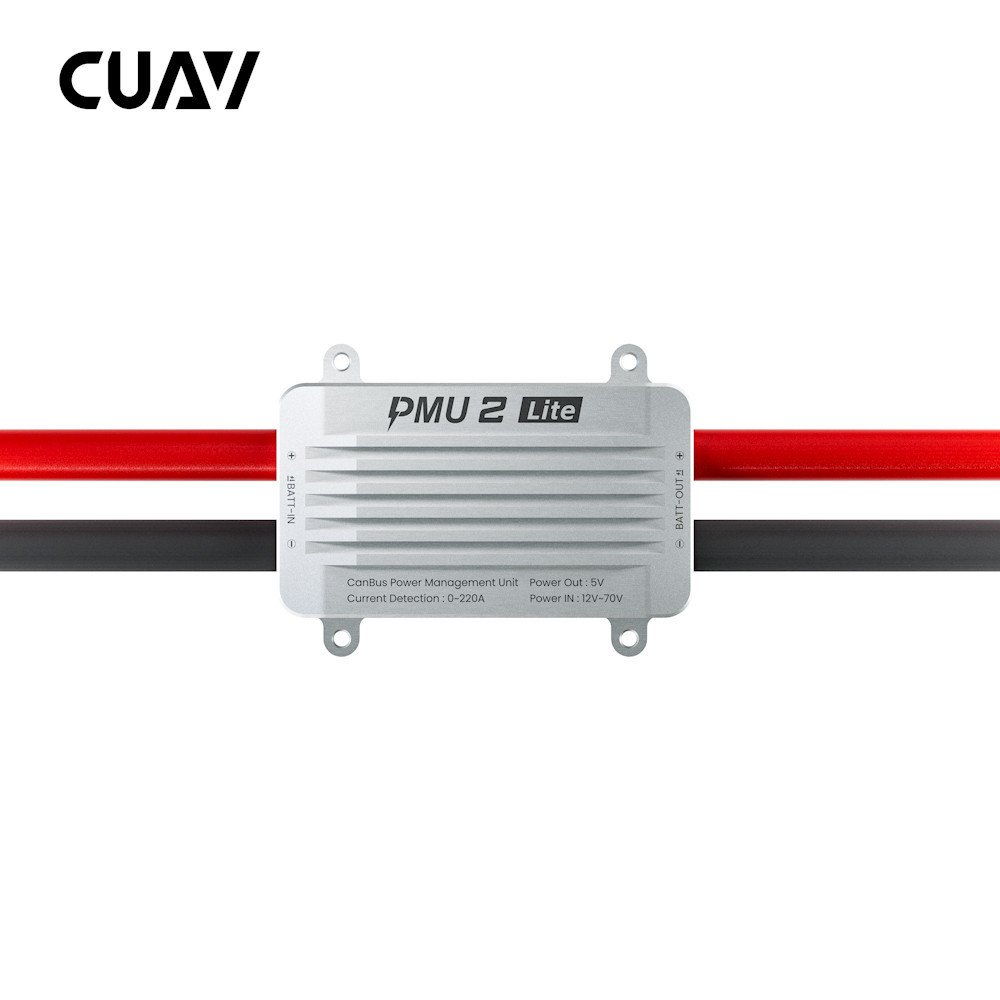
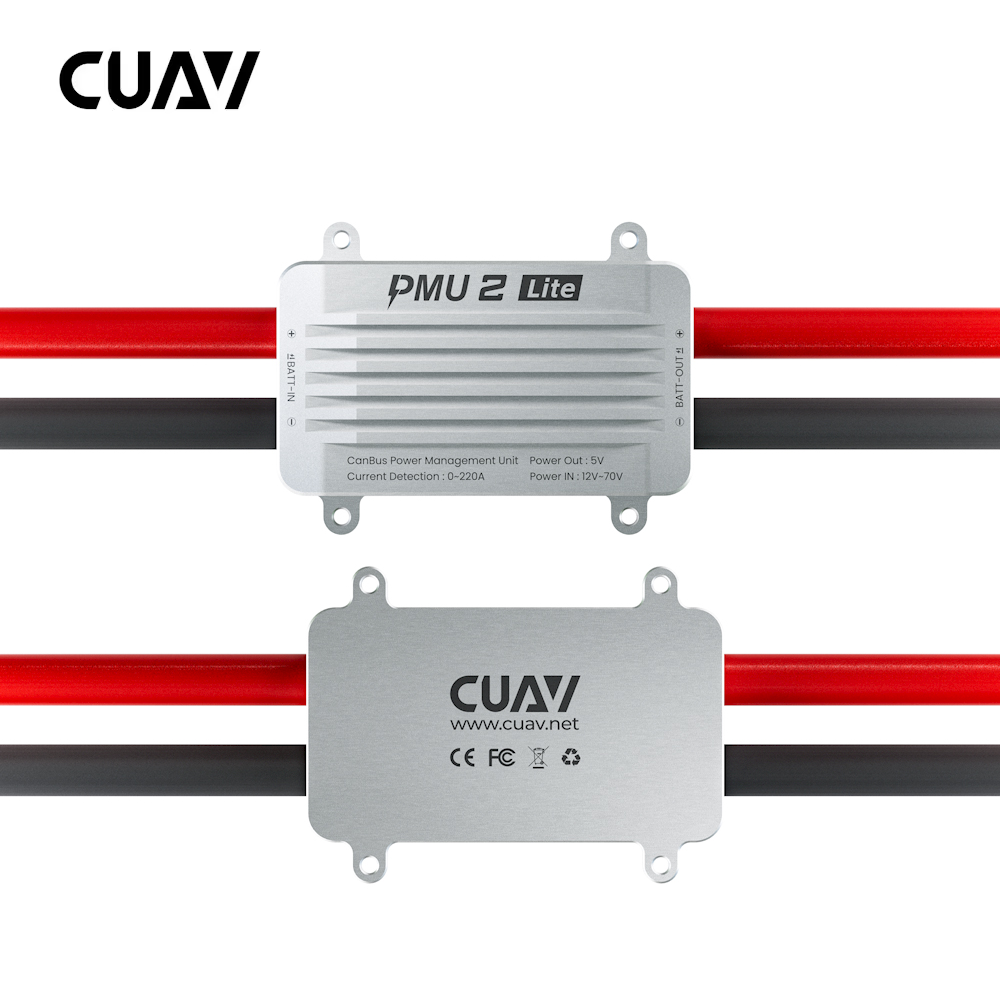
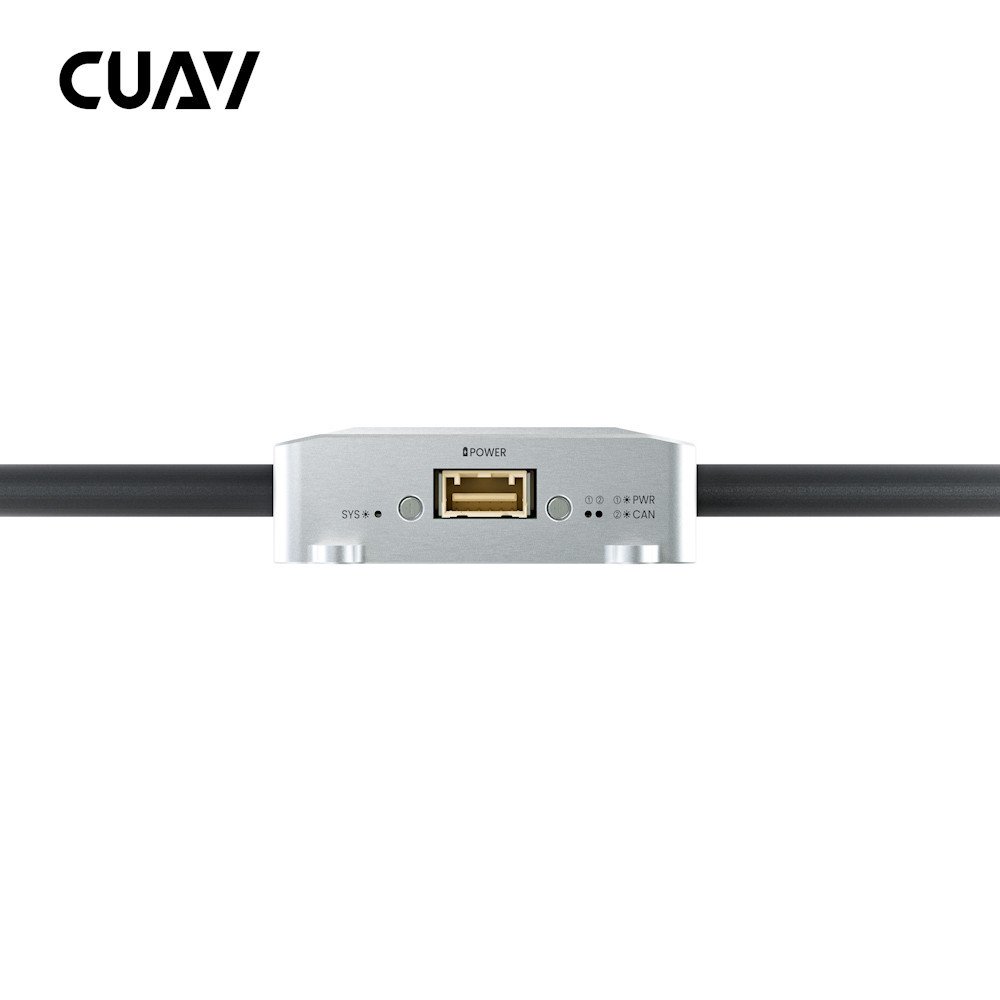
The X25 EVO is supplied with CUAV’s PMU 2 Lite power management module.
This intelligent CAN-based module provides high-precision battery voltage and current monitoring.
Its main features include:
Input Voltage: 20–70 V
Current Measurement Range: Up to 220 A
Digital CAN Communication
High-Precision Voltage & Current Monitoring
Temperature Compensation
The PMU 2 Lite provides regulated power to the X25 EVO and transmits electrical measurements to the flight controller.
The standard configuration uses the compatible 15 V PMU 2 Lite version.
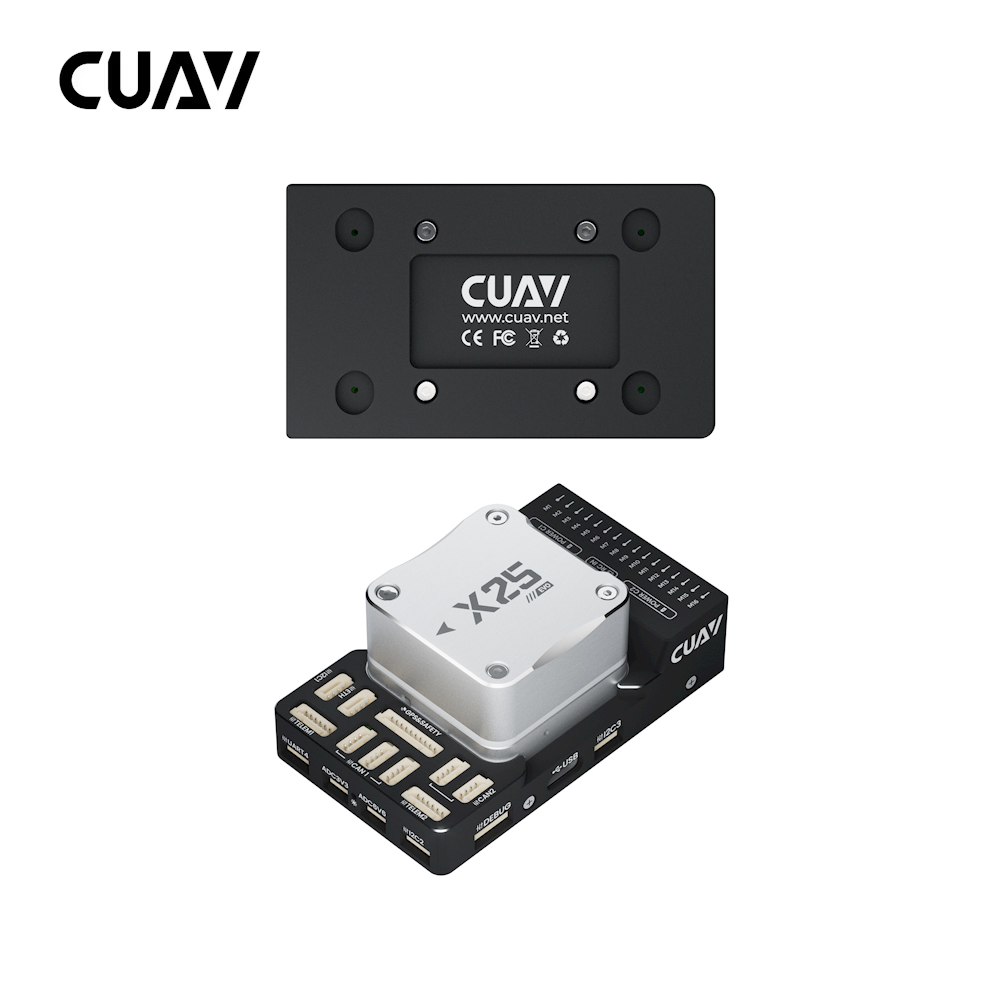
The X25 EVO features a detachable CORE module design.
This modular architecture simplifies maintenance and provides flexibility for professional system integration.
The CORE and baseboard architecture also allows CUAV to offer different hardware configurations for specialized unmanned applications.
The controller includes a multifunction RGB LED indicator.
It provides visual feedback for important system information, including:
Flight Controller Status
Aircraft Arming Status
GNSS Positioning
Battery Status
System Warnings
Device Faults
This simplifies aircraft preparation, diagnostics, and maintenance.
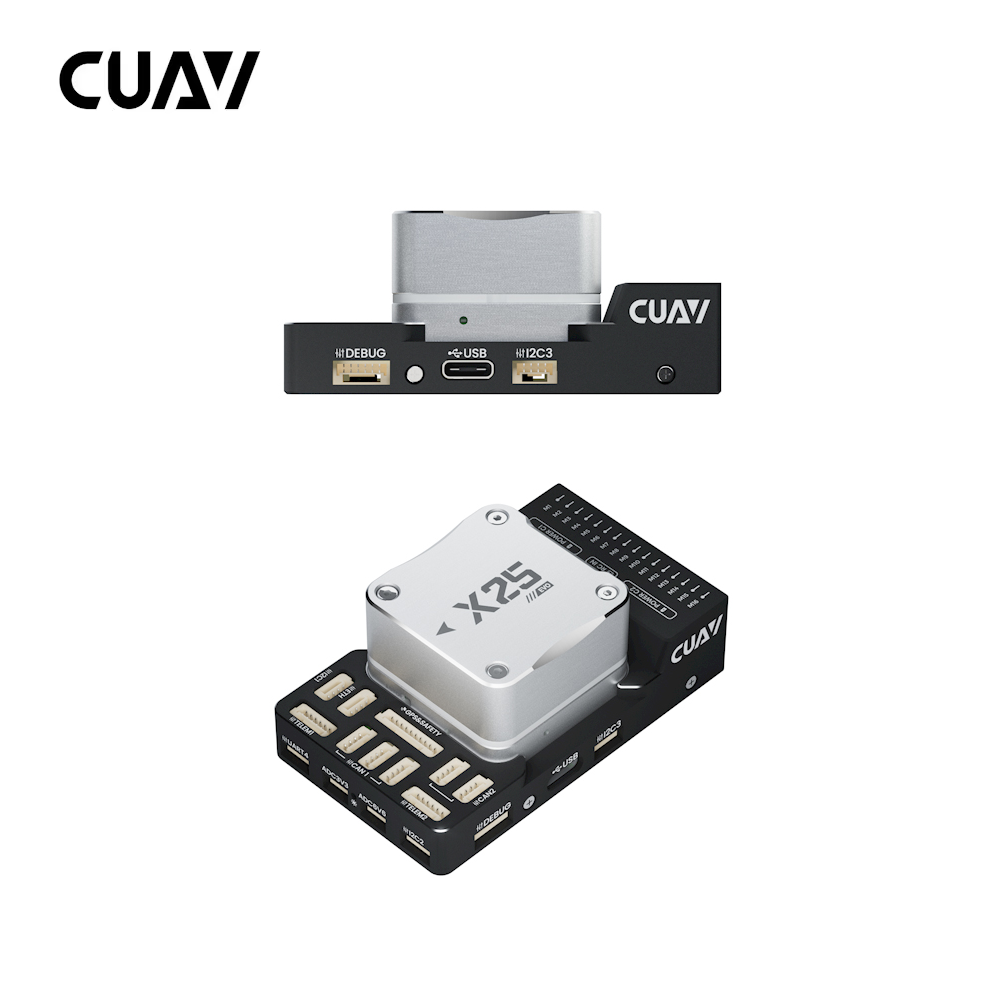
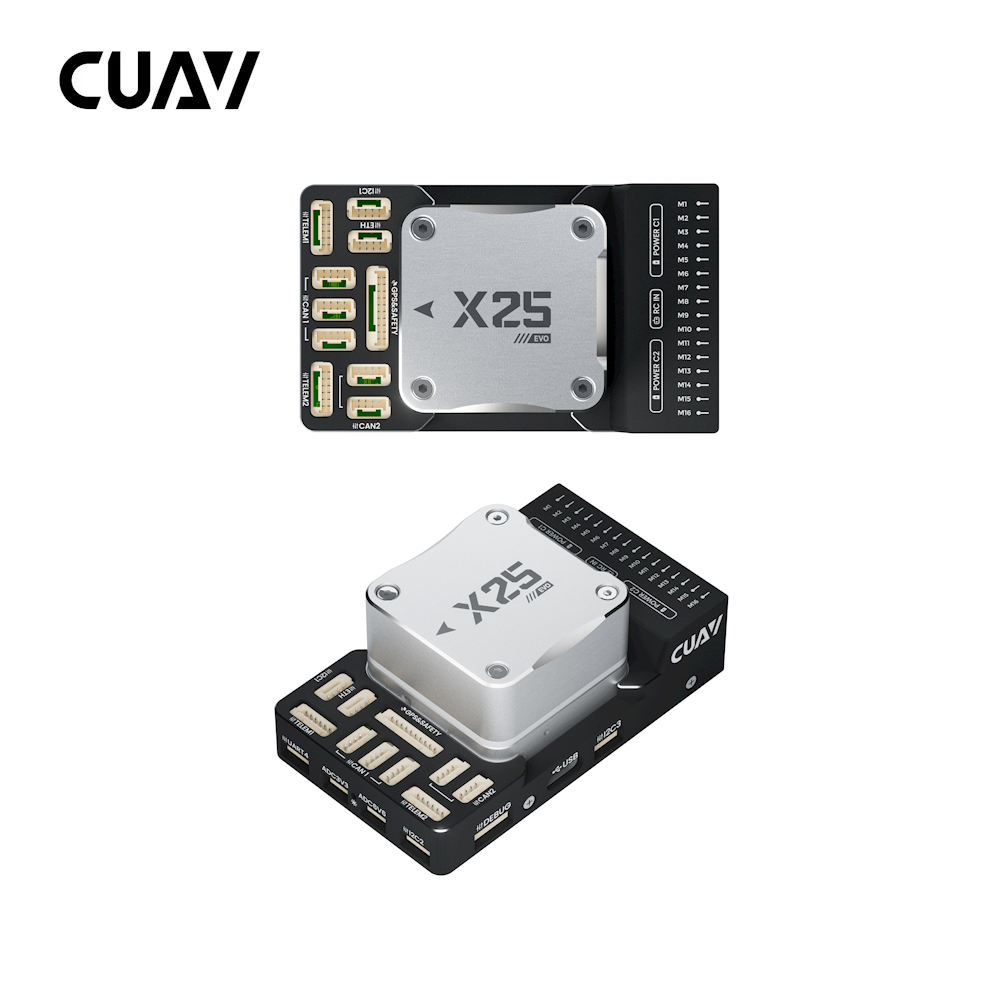
The X25 EVO provides a comprehensive selection of interfaces for professional UAV integration.
16× PWM Outputs
2× GPS Interfaces
2× Telemetry Interfaces
1× UART4 Interface
2× CAN Buses — 5 Physical Connections
3× I2C Interfaces
1× Ethernet Interface
1× SPI6 Expansion Interface
2× CAN Power Inputs
1× RC Receiver Input
1× RSSI Input
1× ADC 3.3 V Input
1× ADC 6.6 V Input
1× Debug Interface
1× USB Type-C Interface
These connections allow integration with navigation systems, telemetry equipment, receivers, sensors, power management modules, and professional UAV payloads.
The X25 EVO supports both ArduPilot and PX4 autopilot firmware.
Compatible vehicle categories include:
Multirotor UAVs
Fixed-Wing Aircraft
VTOL Platforms
Helicopters
Unmanned Ground Vehicles
Unmanned Surface Vehicles
Autonomous Robotic Systems
The controller supports advanced autonomous navigation and flight-control functions available through compatible firmware.
The CUAV X25 EVO is particularly suitable for:
Industrial Multirotor UAVs
Professional VTOL Aircraft
Long-Range Fixed-Wing Platforms
Agricultural Drones
Mapping and Surveying UAVs
Industrial Inspection Platforms
Autonomous Ground Vehicles
Research and Development Systems
Its combination of industrial-grade sensors, advanced vibration isolation, Ethernet connectivity, and high-current power monitoring makes it an excellent choice for professional UAV integration.
Product: CUAV X25 EVO
Brand: CUAV
Module Type: Industrial-Grade Intelligent Autopilot Flight Controller
Main Processor: STM32H753
Processor Architecture: Arm Cortex-M7
Processor Frequency: 480 MHz
Primary IMU: IIM-42653
Secondary IMU: IIM-42652
Third IMU: IIM-42653
IMU Configuration: Triple Redundant
IIM-42653 Gyroscope Range: ±4,000°/s
IIM-42653 Accelerometer Range: ±32 g
IIM-42652 Gyroscope Range: ±2,000°/s
IIM-42652 Accelerometer Range: ±16 g
Electronic Compass: RM3100
Primary Barometer: TDK ICP-20100
Secondary Barometer: Bosch BMP581
Vibration Isolation: Fourth-Generation Tilt-Symmetric Damping Matrix
External Vibration Isolation: Supported
IMU Temperature Compensation: Dual Temperature Compensation System
PWM Outputs: 16
PWM Signal Voltage: Selectable 3.3 V / 5 V
CAN Buses: 2
CAN1 Connections: 3
CAN2 Connections: 2
GPS Interfaces: 2
Telemetry Interfaces: 2
UART4 Interface: 1
I2C Interfaces: 3
SPI6 Expansion Interface: 1
Ethernet Interface: 100 Mbps
RC Input: PPM / SBUS / DSM
RSSI Input: 1
ADC 3.3 V Input: 1
ADC 6.6 V Input: 1
CAN Power Inputs: 2
Debug Interface: DSU
USB Interface: USB Type-C
Flight Controller Power Input: 10–18 V
USB Input Voltage: 4.75–5.25 V
Standard Power Module: CUAV PMU 2 Lite — 15 V Version
PMU 2 Lite Input Voltage: 20–70 V
PMU 2 Lite Current Measurement Range: Up to 220 A
Operating Temperature: -20°C to +85°C
Dimensions: 76.5 × 45.45 × 32.2 mm
Weight: 110 g — Flight Controller
Architecture: Detachable CORE / Baseboard
Firmware Compatibility: ArduPilot / PX4
X25 EVO — Standard Controller
Includes the X25 EVO flight controller and PMU 2 Lite power management module.
X25 EVO + NEO 3 Pro
Includes the standard controller configuration with a CUAV NEO 3 Pro GNSS module.
X25 EVO + NEO 3X
Includes the standard controller configuration with a CUAV NEO 3X GNSS module.
X25 EVO + NEO 4 SE
Includes the standard controller configuration with a CUAV NEO 4 SE GNSS module.
X25 EVO + NEO 4 Nano
Includes the standard controller configuration with a CUAV NEO 4 Nano GNSS module.
X25 EVO + C-RTK 9Ps
Includes the standard controller configuration with the selected C-RTK 9Ps positioning solution.
X25 EVO + C-RTK 2HP
Includes the standard controller configuration with the selected high-precision RTK positioning and heading solution.
X25 EVO + C-RTK 3 G5
Includes the standard controller configuration with the selected C-RTK 3 G5 RTK positioning system.
X25 EVO + C-RTK 3 X20P
Includes the standard controller configuration with the selected C-RTK 3 X20P RTK positioning system.
Standard X25 EVO Package
1× CUAV X25 EVO Flight Controller
1× CUAV PMU 2 Lite — 15 V Version
1× CAN Expansion Board
2× CAN Cables — 35 cm
1× USB Type-C Cable — 100 cm
2× TELEM Cables — 30 cm
1× RSSI Cable — 25 cm
1× RC IN Cable — 30 cm
1× PMU 2 Lite Power Cable — 30 cm
1× GPS Connection Cable — 30 cm
1× UART4 Cable — 30 cm
1× Ethernet Cable — 40 cm
1× ADC 3.3 V Cable — 25 cm
1× ADC 6.6 V Cable — 25 cm
1× TF / MicroSD Memory Card
4× Flat-Head Hex Socket Screws
4× Socket Head Cap Screws
4× Silicone Mounting Supports
GNSS modules, RTK equipment, and additional accessories are included only when explicitly selected in the corresponding bundle.
Flight controller firmware must be installed and configured before operation.
The X25 EVO requires a regulated 10–18 V power supply. Do not connect the aircraft battery directly to the controller unless an appropriate power regulation system is used.
The 220 A specification refers to the PMU 2 Lite current measurement range, not the continuous current rating of the flight controller.
The 110 g weight refers to the X25 EVO flight controller and excludes the external power module and accessories.
-Industrial-grade STM32H7 autopilot with triple redundant IMUs, advanced vibration isolation.
-16 PWM outputs, 100 Mbps Ethernet, dual CAN, and PMU 2 Lite power management.